Almost every day, foreigners call us with the same question: is there any way we can “help” them with their language exam, get the necessary certificate without training or actually taking it? Sometimes people ask this question cautiously, indirectly. Others ask directly. They think it’s just a formality that can be bypassed if they find the “right person” and pay money.
And today, news came from the Czech Republic that very clearly shows how such attempts end.
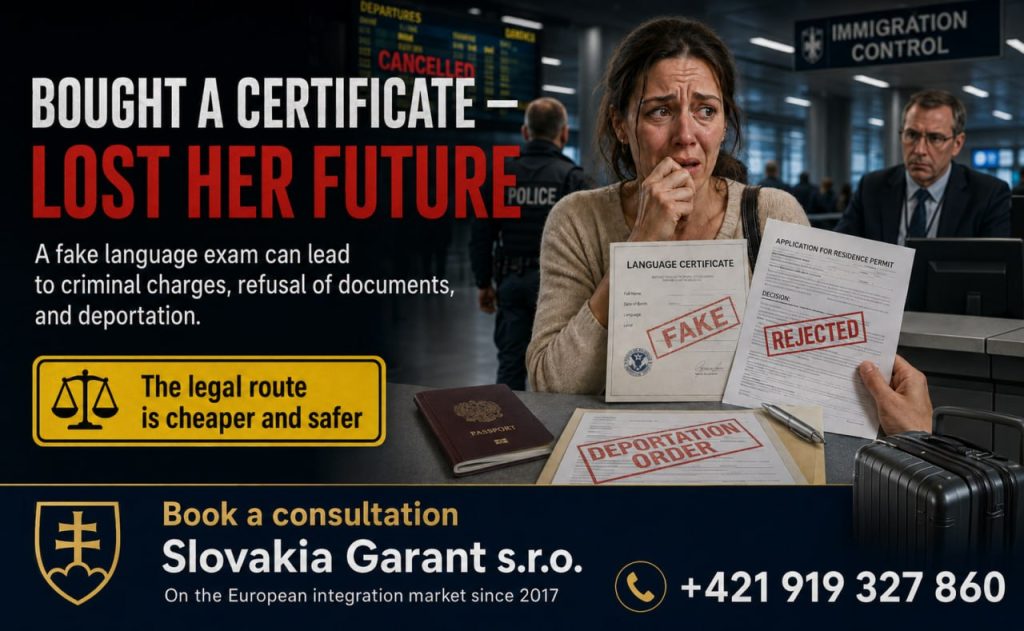
Czech police officially reported the case of a 40-year-old foreign woman who applied for permanent residence and submitted a certificate of passing a Czech language exam. At first glance, everything seemed normal. However, an immigration officer was unable to confirm that she had passed the exam and contacted the educational institution that allegedly issued the certificate.
The answer was clear: the woman had not taken such an exam there.
After an inspection and expert examination, the police determined the document was counterfeit. During questioning, the foreigner admitted to purchasing the certificate from an unknown man for nearly 150,000 Czech crowns (approximately 6,200 euros). She explained that she didn’t know Czech well enough and wasn’t confident she could pass the exam on her own.
As a result, instead of smoothly registering her permanent residence, the woman was charged with a criminal offense. She is suspected of forging and using an official document. According to Czech police, she faces up to three years in prison.
And it’s important to understand: this isn’t some distant story that only affects the Czech Republic. The outcome in Slovakia could be very similar.
Slovak authorities check documents, contact educational institutions, query registers, and can verify whether a person actually completed the training and passed the exam. A certificate is more than just a piece of paper with a stamp. It has an origin, a number, the issuing institution, and verifiable data.
If a person submits a forged document to a government agency, the issue is no longer limited to a residence permit denial. Criminal liability for forgery or use of an official document may arise. Furthermore, refusal, revocation of already granted status, administrative expulsion, and entry bans may be considered by the competent authorities separately, taking into account the circumstances of the individual case.
Moreover, all this is especially pointless, because the legal route is many times cheaper.
In Slovakia, the language exam required for long-term residence in cases specified by law corresponds to level A2. This is a basic level that doesn’t require reading complex literature, engaging in professional discussions, or speaking like a native speaker. A candidate should understand simple questions, be able to talk about themselves, their family, work, and living in Slovakia, and handle common everyday situations. The Slovak Ministry of the Interior states that the language difficulty of this exam corresponds to level A2.
Preparatory courses can be found for around 200 euros. The exam itself, depending on the school and its conditions, can also cost around 200 euros. Prices should be confirmed directly with the chosen educational institution, but on average, for around 400 euros, a person can complete the preparation, acquire the necessary knowledge, and pass the exam legally.
Compare for yourself: about 400 euros for training, real knowledge, and a legitimate certificate, or thousands of euros to an unknown intermediary, a fake document, a criminal case, and the risk of losing the right to live not only in one country, but also to enter the Schengen zone for a long period.
Sometimes people think the main thing is to get a card once, and then no one will check anything. But a person’s migration history doesn’t end the day the document is issued. The next step may include extending temporary residence, transitioning to permanent residence, long-term status, family reunification, or obtaining citizenship. At each new stage, government agencies re-examine the documents and previous grounds for residence.
A counterfeit certificate can be discovered not only today but also in a year, three, or five years, when a person has already built a life in Slovakia, moved their family, opened a business, purchased real estate, and thinks all this is in the past.
But illegal decisions don’t last long. People begin to fear every inspection, every official letter, and every call from the police. They realize that their entire future life is essentially built on a document that could be declared counterfeit at any moment.
There’s no point in starting a new building on a rotten foundation. Even if the walls look beautiful, there’s always a lingering fear that one day everything will collapse. It’s far wiser to act correctly from the start, comply with the law, and not be afraid of every rustle and creak of a door because you once decided to deceive the state.
For those seeking to understand how to legally obtain documents for residency in Slovakia, obtain temporary protection, transition to a temporary residence permit, subsequently obtain permanent residency, and, if applicable, Slovak citizenship, we recommend first obtaining professional advice and developing the right migration strategy.
You can contact Slovakia Garant. Our office is located in the center of Bratislava, in the Old Town, at Gorkého 3, third floor. We are open from 9:00 AM to 5:00 PM every day except weekends and help foreigners navigate immigration procedures in a legal, transparent, and secure manner.