The Slovak Ministry of the Interior has published updated data on the number of foreigners with valid residence status in the country. The report covers the first half of 2026 and shows the situation as of June 30.
It’s important to clarify one point right away. The statistics do not indicate the exact number of people physically present in Slovakia on that day, but rather the number of valid permits and official residence statuses. A person may have temporarily left the country, but their temporary residence permit, permanent residence permit, or temporary protection remains valid.
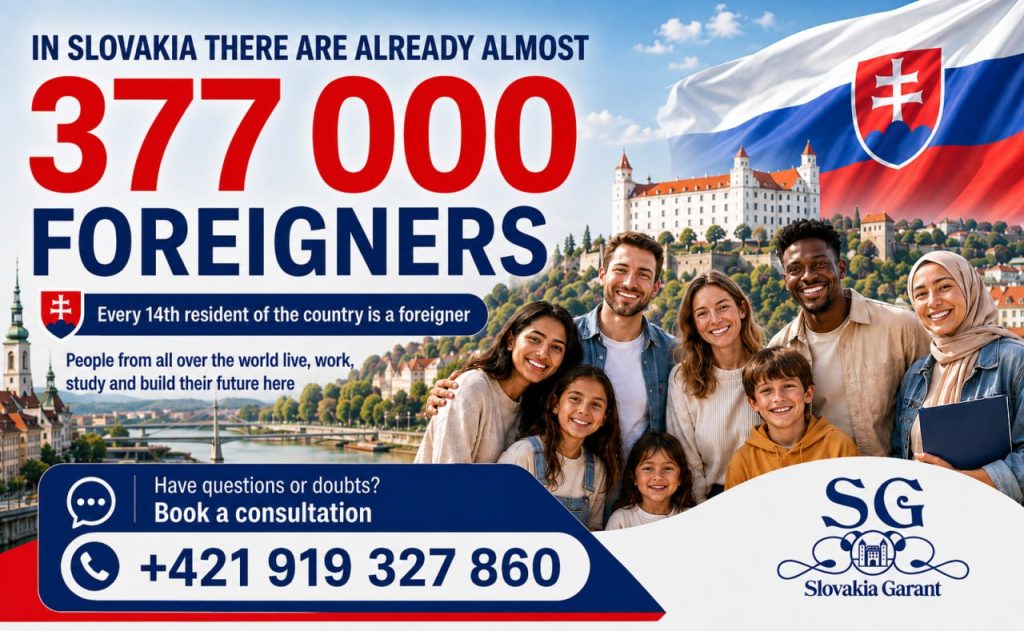
As of June 30, 2026, there were 376,832 valid residence statuses registered in Slovakia for foreigners. Of these, 320,936 belonged to citizens of so-called third countries, i.e., countries outside the European Union. Another 55,896 valid statuses belonged to citizens of EU countries.
At the end of 2025, the total number of such statuses stood at 360,440. Thus, in just the first six months of 2026, their number increased by 16,392, or approximately 4.5 percent.
Compared to the situation a year earlier, the increase is even more significant. As of June 30, 2025, 342,048 valid residence permits for foreigners were registered in Slovakia. This represents an increase of 34,784 in just one year, or more than 10 percent.
This is no longer just a statistical fluctuation. These figures demonstrate that Slovakia is gradually changing its place on the European migration map. While previously, for many foreigners, the country was more of a stopover en route to Germany, Austria, the Czech Republic, or other Western European countries, today more and more people are staying here for the long term, working, starting businesses, studying, bringing their families, and making plans for the future.
Ukrainian citizens remain the clear leaders. As of June 30, 2026, they held 221,920 valid residence permits. This represents almost 59 percent of all foreigners in the country and over 69 percent of third-country nationals.
However, not all Ukrainians are in Slovakia under temporary protection. Of the total, 146,459 had tolerated stay, which in Slovak statistics includes temporary protection status. Another 56,299 Ukrainian citizens held temporary residence permits, and 19,162 have already received permanent residence permits.
Thus, 75,461 Ukrainian citizens resided in Slovakia not under temporary protection, but on standard migration grounds. These include employment, entrepreneurship, education, family reunification, permanent residence, and other legally prescribed grounds.
Compared to the end of 2025, the number of Ukrainian citizens with valid statuses increased by 9,675. Therefore, the claim that the number of Ukrainians increased by approximately 10,000 over the past six months is generally consistent with official data.
Serbian citizens are in second place. There are 14,564 registered Serbian citizens in Slovakia. However, unlike Ukrainians, their number is declining. In the first six months of 2026, it decreased by 918.
Vietnam ranks third. Citizens of this country held 14,236 valid residence statuses. However, Vietnam has seen significant growth. In just six months, the number of Vietnamese citizens increased by 1,700, an increase of almost 14 percent.
Next are Russian citizens. As of June 30, 2026, 9,165 Russian citizens were registered in Slovakia. Over the past six months, their number has increased by only 134.
India is close behind with 8,916 citizens. Over the past six months, the number of Indian citizens has grown by 876, or nearly 11 percent.
The number of citizens from Asian countries has increased particularly rapidly. The number of citizens from the Philippines has increased from 2,573 to 3,607, an increase of approximately 40 percent. The number of citizens from Uzbekistan has increased by 915, bringing the total to 3,316.
Nepal has shown even more significant growth. The number of citizens from this country has increased from 1,409 to 2,259, an increase of more than 60 percent in just six months.
The number of Chinese citizens increased more moderately, from 3,510 to 3,728. At the same time, the number of Georgian citizens continued to decline, falling from 4,108 to 3,599, as did the number of North Macedonian citizens, which fell from 3,066 to 2,954.
Some publications reported that citizens of Nigeria and Pakistan were included in Slovakia’s statistics for the first time. This is not true. At the end of 2025, 327 Nigerian and 189 Pakistani citizens were already registered in the country. By June 30, 2026, their numbers had increased to 341 and 269, respectively.
It’s equally interesting to look at the specific statuses of third-country nationals residing in Slovakia.
Temporary residence permits, known as prechodný pobyt in Slovak, were held by 124,935 people. This category increased by 5,412 people over the first six months.
Permanent residence permits, known as trvalý pobyt, were held by 48,635 people. This number increased by 2,412 over the first six months.
Another 147,366 people had tolerated stays. It’s important not to overly broadly use the term “various humanitarian statuses” here, as almost all of this category consists of people with temporary protection.
Of the 147,366 people, exactly 147,346 had temporary protection status. Another 14 cases involved unaccompanied minors, and six permits were granted due to the need to respect private and family life.
Persons granted asylum or subsidiary protection are reflected in other sections of the statistics. As of June 30, 2026, there were 377 people with refugee status in Slovakia, as well as 120 people with subsidiary protection.
Therefore, automatically lumping temporary protection, asylum, subsidiary protection, and tolerated stay into a single category is legally incorrect. Each of these statuses has its own grounds, rights, validity periods, and renewal rules.
The geography of foreigners’ residence also reveals much about how the country is changing.
The largest number of third-country nationals remains registered in the Bratislava Region. Their total number is 111,103. Of these, 44,630 have temporary residence permits, 19,476 have permanent residence permits, and 46,997 are under tolerated residence, primarily under temporary protection.
Therefore, in the Bratislava Region, more than 64,000 third-country nationals have regular temporary or permanent residence permits, and another 47,000 reside under tolerated residence status.
The Košice Region ranks second, with 49,623 registered third-country nationals. This region also saw the most significant growth. Compared to June 2025, the number of foreigners here has increased by more than 12,000. A significant portion of this increase is due to people with temporary protection.
The Nitra Region has 38,735 registered foreigners, Trnava Region 34,096, Žilina Region 25,208, Prešov Region 24,739, and Trenčín Region 20,944.
The Banská Bystrica Region again has the lowest number of foreigners, with 16,488 registered third-country nationals. Of these, 8,543 have temporary or permanent residence permits, and 7,945 are under a tolerated stay.
The Košice Region ranks second, with 49,623 registered third-country nationals. This region also saw the most significant growth. Compared to June 2025, the number of foreigners here has increased by more than 12,000. A significant portion of this increase is due to people with temporary protection.
The Nitra Region has 38,735 registered foreigners, Trnava Region 34,096, Žilina Region 25,208, Prešov Region 24,739, and Trenčín Region 20,944.
The Banská Bystrica Region again has the lowest number of foreigners, with 16,488 registered third-country nationals. Of these, 8,543 have temporary or permanent residence permits, and 7,945 are under a tolerated stay.
Compared to June 2025, the increase is almost 17,000 people. This is clearly not a random fluctuation, but a stable trend.
Slovakia is increasingly attracting workers from third countries. The reason is quite clear. Many industries are experiencing a shortage of local labor, so employers are increasingly looking to Vietnam, India, Uzbekistan, Nepal, the Philippines, and other countries.
The situation with entrepreneurial residence permits is developing in the opposite direction. At the end of 2025, 38,482 people held residence permits for the purpose of entrepreneurship. By June 30, 2026, this number had dropped to 31,311.
The decline in just six months was 7,171 people, or almost 19 percent. Compared to June 2025, this category has decreased by more than 9,000 people.
This decline coincided with the introduction of new rules for obtaining entrepreneurial residence permits. Effective July 1, 2025, Slovakia began regulating the number of new applications accepted by consulates. The overall annual quota was set at 700 applications.
Furthermore, new applicants are required to submit a business plan and an assessment of the feasibility and economic viability of their planned activities. The state wants to see not just a registered company or a business license, but a clear business model, real intentions, and the economic benefits of future activities.
However, it would be wrong to attribute the entire reduction solely to the introduced quotas. The quota limits the number of new applications, but the total number of valid entrepreneurial residence permits also depends on other factors.
It matters whether people renew their previously obtained permits, whether they conduct actual business, whether they fulfill their tax obligations, whether the stated purpose of their stay is maintained, whether they switch to employment or other grounds, and even whether they continue to live in Slovakia at all.
In other words, the migration system is increasingly separating real businesses from formal enterprises created primarily for the purpose of obtaining documents.
The number of residence permits for the purpose of study reached 19,308. In the first six months of 2026, this number increased by 1,975.
A total of 18,694 people held temporary residence permits based on family reunification, an increase of 355 compared to the end of 2025.
Long-term residence permits (dlhodobý pobyt) were held by 33,574 people. This number increased by 2,076 people over the past six months.
Permanent residence permits (trvalý pobyt na päť rokov) for five years were held by 4,911 people. This number increased by 102 compared to the end of 2025.
The EU Blue Card deserves special attention. It is often talked about as one of the main tools for attracting highly qualified specialists. However, as of June 30, 2026, only 168 such statuses were valid in Slovakia.
This is almost double the number at the end of 2025, when 87 Blue Cards were valid. Therefore, it would be wrong to claim that this mechanism is completely ineffective. There is growth, but in absolute terms, its role remains minimal.
Compared to nearly 47,000 work-related residence permits, only 168 active Blue Cards truly seems very modest. It’s important to understand that this refers to the number of valid statuses as of a specific date, not the total number of Blue Cards ever issued by Slovakia.
There’s another important detail. The statistics are based on June 30, 2026. Therefore, changes to immigration legislation that came into effect on July 15, 2026, could not yet have affected these figures.
The real impact of the new rules will only be assessed after the publication of the next reports from the Slovak Ministry of the Interior.
The main conclusion is that Slovakia is not closing itself off to foreigners. Their overall number continues to grow quite rapidly. However, at the same time, the state is changing its priorities and becoming more demanding regarding the right of residence.
The country needs workers, students, qualified specialists, genuine entrepreneurs, and families who plan to live here long-term. At the same time, formal schemes, companies without real activity, and attempts to obtain a residence permit without a clear economic or personal purpose are being increasingly scrutinized.
Today, simply choosing a popular basis for residence is no longer enough. You need to assess in advance whether it suits your actual situation, whether you can support it with documents, whether your status can be extended in a year or two, and whether the chosen path will lead to the desired outcome.
If you’re planning to obtain or renew a temporary residence permit, change your residence permit, find employment, start a business, study, reunite with family, or transition from temporary protection to another status, contact Slovakia Garant for professional advice. We’ll analyze your situation, explain your realistic options, and help you build a legal and secure path to residency in Slovakia.
Slovakia Garant
Gorkeho 3, Bratislava
+421 919 327 860