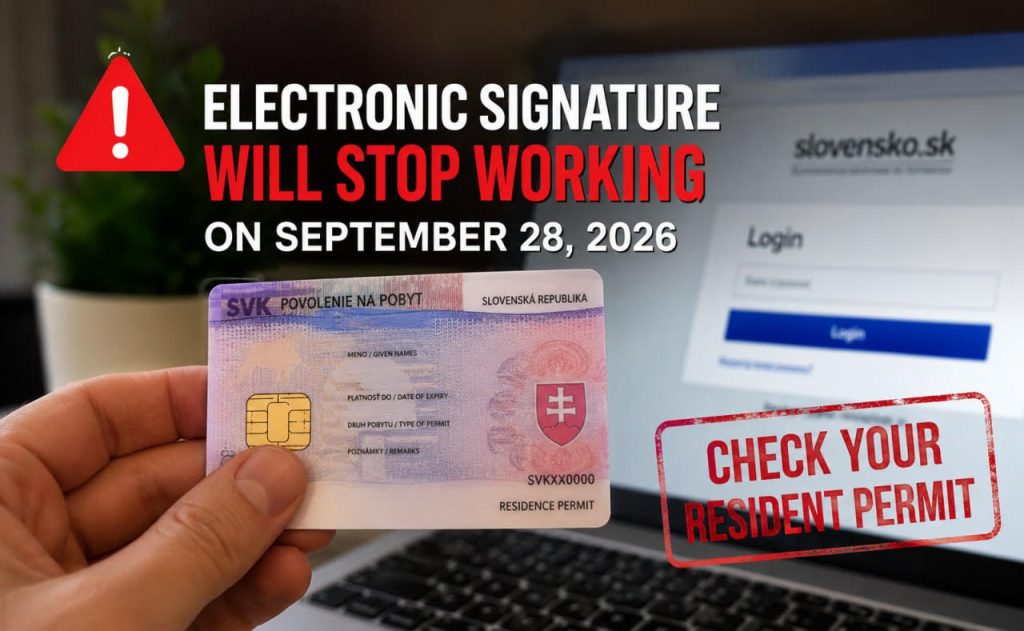
In September, Tens of Thousands Will Lose the Ability to Use Electronic Signatures in Slovakia
At the end of September, a change will take place in Slovakia that may appear purely technical at first glance, but for some foreigners it could unexpectedly create very practical problems. The issue concerns residence cards for temporary and permanent residence, which many people are used to viewing simply as documents confirming their right to stay. In reality, an electronic residence card can perform many more functions: it can be used to access government e-services, use the electronic mailbox on Slovensko.sk and, if the appropriate certificate is installed, sign documents with a qualified electronic signature.
On August 25, 2026, the Slovak Ministry of the Interior officially announced that the chip certification on certain electronic identity cards and foreigners’ residence documents is expiring. This concerns documents with a CardOS v5.4 chip that were issued by the Ministry of the Interior between June 21, 2021 and November 30, 2022. According to the Ministry, approximately 130,000 holders of these documents currently have a qualified electronic signature certificate — KEP — installed on their cards. On September 28, 2026, these certificates will automatically expire for this type of chip.
For foreigners, the most important thing is to immediately distinguish one issue from another. The residence card itself does not become invalid on September 28. If your pobytový preukaz is still within its validity period, the document remains valid and continues to confirm your legal status in Slovakia. Your temporary residence will not be cancelled, your permanent residence will not be terminated, and you do not need to submit a new residence application solely because of this technical issue.
The change specifically concerns the ability to use the card to create a qualified electronic signature.
And that is a significant distinction. A person may live in Slovakia for years with a residence card and never use KEP at all. For them, practically nothing will change after September 28. But if a foreigner runs a business, is a company director, independently communicates with government authorities through Slovensko.sk, submits electronic applications or regularly signs documents electronically, the issue becomes much more important.
KEP, or kvalifikovaný elektronický podpis, is effectively the electronic equivalent of a handwritten signature in the Slovak system. The official Slovensko.sk portal explicitly states that, under the European eIDAS Regulation, a qualified electronic signature has the same legal effect as a handwritten signature. And where required by law, if it is accompanied by a qualified electronic time stamp, such authorization may have the effect of an officially certified signature.
Therefore, the problem is much broader than simply “you will no longer be able to log in to Slovensko.sk.”
A cardholder will still be able to access many government e-services if they have an activated BOK — bezpečnostný osobný kód. BOK is used for identification and logging into the electronic system. However, logging into a system and legally signing a document are two completely different operations.
Here is a very simple example. You may be able to open your electronic mailbox, read a message from a government authority or access a particular electronic service. In some cases, authorization through the card and BOK is sufficient for this. But if you need to submit an application that must be legally signed, the system may require an electronic signature. This is where the absence of a valid KEP can become an obstacle.
This is particularly relevant for foreigners because the Slovak system is gradually moving more and more administrative procedures into electronic form. Moreover, the Ministry of the Interior itself provides foreigners with electronic services that explicitly require an electronic residence card, BOK and KEP. For example, in the official description of the electronic service for issuing a residence document, the Ministry states that the applicant must have an electronic doklad o pobyte, an activated BOK and a qualified electronic signature. The electronic application itself is authenticated using KEP.
In other words, for someone who actually uses government e-services, this is not merely a theoretical problem.
There is another important detail that may currently cause some confusion. Since August 27, 2026, the Ministry of the Interior has allowed another certificate to be installed on affected documents — one for the so-called uznaný spôsob autorizácie, or recognized method of authorization. A new version of the eID Client software has already been released for this purpose. This means that the government has created a temporary way to continue using some electronic services without immediately replacing the card.
However, it would be a mistake to treat this as a complete replacement for KEP.
The uznaný spôsob autorizácie is an advanced electronic signature based on a qualified certificate. According to official information from Slovensko.sk, this method can be used only for certain electronic submissions and only where it is accepted by the relevant government authority. It primarily applies to the electronic application itself, while the requirements for electronic attachments and documents may differ. If a particular procedure specifically requires KEP, the recognized method of authorization may not be sufficient.
This is precisely why foreigners should not conclude: “They will install a new certificate for me, so I don’t need to change anything at all.”
The first step is to understand how you actually use your card.
If you mainly need the card as proof of temporary or permanent residence, for travel together with your passport and for ordinary identification, and you do not use an electronic signature, there is no need to urgently replace the document solely because of September 28. Your residence status will not disappear because of this.
If, however, you use the card for KEP, electronic applications, communication with government authorities, business-related procedures or signing documents, it is better to check the situation in advance rather than wait until September 29, when you may suddenly need to submit an important application.
Foreigners whose residence cards were issued between June 21, 2021 and November 30, 2022 should pay particular attention. This is the period the Ministry of the Interior associates with documents equipped with the CardOS v5.4 chip that is currently affected.
And this is where another common mistake arises. A person looks at the expiry date of their card and thinks: “It is still valid for several more years, so why should I replace it?” From the perspective of immigration status, they are right. From the perspective of the electronic signature, however, they are not. The physical document can remain valid while the certificate inside its electronic chip will no longer allow the creation of a KEP.
For those who specifically need a fully qualified electronic signature, the Ministry of the Interior recommends obtaining a new document. For Slovak citizens, this means contacting a police department that issues identity documents. For foreigners, it means contacting the relevant cudzinecká polícia office to obtain a new doklad o pobyte.
This is where a very practical issue arises for foreigners: do not postpone the decision until the last days of September. If a large number of cardholders decide to replace their documents at the same time, police departments may face additional demand and difficulties with available appointment slots. This may be particularly noticeable in Bratislava and other cities with large foreign populations.
The logic of what to do is therefore quite simple. If your pobytový preukaz was issued between June 2021 and November 2022, first check whether you actually use KEP and whether the relevant qualified certificate is installed on your card. If you do not use it and the card is sufficient for you as a residence document, with BOK providing access to electronic services, the date of September 28 does not mean that you are required to immediately replace the card.
If KEP is part of your work or your interaction with government authorities, you should separately determine whether the new uznaný spôsob autorizácie is sufficient for you or whether your procedures require a full KEP. If you specifically need KEP, it is safer to arrange a new document in advance.
There is one more important point. BOK and KEP should not be confused. BOK is the code that allows you to identify yourself and log into electronic government services. KEP is a legally significant electronic signature. Therefore, the statement “the card will continue to work” can be both correct and misleading at the same time. For logging in, the card may indeed continue to work. For qualified electronic signing after September 28, however, it will not — if we are talking specifically about the affected CardOS v5.4 chip and the old certificate.
Therefore, for most foreigners, this is not a reason to panic, and certainly not a problem with the legality of their residence in Slovakia. But for entrepreneurs, company directors and people who are accustomed to handling matters through electronic government services, this is an administrative risk that is better addressed in advance.
We recommend not simply checking the card’s expiry date, but also checking its date of issue, how you use it electronically and whether KEP is installed. If you are unsure whether the change affects your particular card, whether you need to replace it, or which electronic actions you will be able to perform after September 28, 2026, it is better to clarify the situation before you urgently need to submit or sign a document. Specialists at Slovakia Garant can assess your situation, explain whether you need to replace the card in your particular case, and help you organize the next steps correctly.
There is one important detail that I changed compared with the original publication: I would not simply write that the uznaný spôsob autorizácie “is not a full replacement for KEP” and leave it at that. Formally, it does allow users to sign a number of electronic submissions, but its application depends on the specific service and the requirements of the relevant authority. The official Slovensko.sk website specifically warns that it does not automatically replace KEP in all procedures and does not apply in the same way to attachments submitted with applications.