Updated Rules for Children Attending Kindergarten
Sometimes rules that may seem strict at first glance are actually not about the government’s desire to control people, but about something completely different — how seriously it takes children and their future.
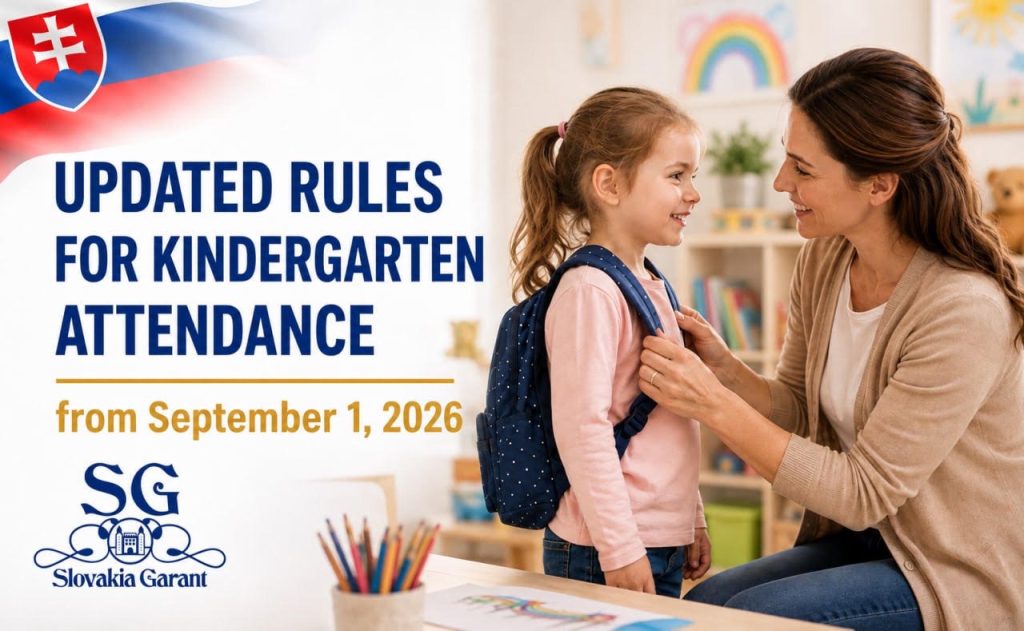
Starting September 1, 2026, Slovakia is introducing updated rules for children attending kindergarten who are completing compulsory pre-primary education. This primarily concerns five-year-old children who have one final year before starting school.
For foreigners, it is important to understand the philosophy behind these changes correctly. This is not about the government trying to make life more difficult for parents, ban family trips, or put a supervisor over every child. The idea is completely different. Slovakia follows a simple logic: if a child is expected to sit at a school desk in a year, the state wants to make sure that the child is genuinely ready for it.
You understand this particularly well when you come to Slovakia from another country.
For a Slovak child, kindergarten is preparation for school. For a foreign child, this final year can be even more important. They need not only to learn how to count, draw, concentrate, listen to their teacher, and work together with other children. They also need to enter a new language environment, get used to understanding Slovak, learn how to express their thoughts, and stop feeling like an outsider among their peers.
None of this can be achieved in just a few weeks before starting first grade.
That is precisely why compulsory pre-primary education for five-year-old children in Slovakia is not merely a formality. The state considers kindergarten an important part of education. And if a child is regularly absent, a perfectly logical question arises: will they be able to start school properly later on?
Slovak Minister of Education Tomáš Drucker, explaining the new rules, spoke precisely about this: the goal is for children to have language skills, acquire basic abilities, and be able to cope with the school curriculum by the age of six. Because if a child misses what other children are learning every day in kindergarten, it will objectively be more difficult for them at school.
From September, the system will become somewhat more structured. Kindergartens will operate under one of two systems for excusing a child’s absence due to illness without a medical certificate.
For most kindergartens, a more flexible system will apply. Under this system, parents will be able to declare their child ill for up to seven consecutive school days themselves. Without a doctor’s certificate, parents will be able to excuse no more than 14 school days in a calendar month and no more than 21 school days over two consecutive months.
There are also kindergartens where a stricter system will apply. These are primarily institutions with a high level of student absenteeism. To determine which system applies, the state has established a specific benchmark — 75 missed school days. Under the stricter system, parents can still excuse an illness lasting up to seven consecutive school days without a medical certificate, but the overall limit is 21 school days per semester.
And here there is a very important detail that has been missed in many publications on this topic.
Nobody is saying that after 21 days a child is prohibited from being absent from kindergarten or that parents are no longer allowed to keep their child at home. The issue is specifically about proving illness without a doctor’s certificate. Once the established limits are exceeded, an absence due to health reasons will need to be supported by a medical document.
In other words, the system is quite logical and manageable.
As long as a child occasionally gets sick, as happens in practically every family, the state trusts the parents. There is no need to run to the doctor after every runny nose simply to get a piece of paper. But if absences become prolonged or systematic, parents are required to provide confirmation of the reason.
For foreign parents, in my opinion, this is a particularly telling example of how Slovakia’s social system works.
The state clearly operates on the principle that the interests of the child can sometimes take priority over the convenience of adults. Parents may have their own plans, trips, jobs, businesses, and family circumstances, but a child has their own right — to receive proper preparation for school.
And the state protects that right.
Of course, if parents systematically fail to ensure their child receives compulsory pre-primary education and unjustified absences occur, the consequences can become more serious. The law provides for administrative liability, a fine may be imposed, and information about prolonged failure to fulfill parental obligations may be passed on to the municipality and social protection authorities.
But even here, it is important not to create an atmosphere of fear around the issue.
This is not a system looking for an excuse to punish a normal family. If a child is sick, there are clear rules. If serious family circumstances arise, they can be explained. If medical confirmation is required, it can be provided. Problems arise primarily when parents simply ignore their child’s compulsory education and treat kindergarten attendance as optional for months at a time.
This, perhaps, is one of the aspects of life in Slovakia that foreigners need to understand.
There is a lot of freedom here, but that freedom comes with a fairly clear sense of responsibility. The state tries not to interfere in family life unnecessarily, but when it comes to education, health, and a child’s future, certain rules must be followed by everyone — both Slovaks and foreigners.
For children of foreign families, this can turn out to be a huge advantage.
A full year of meaningful interaction with Slovak children before starting school can change a great deal. A child enters first grade not as someone entering a completely unfamiliar environment. They know the language at least at a basic everyday level, understand teachers’ instructions and classroom routines, are familiar with local behavioral expectations, know how to communicate with their peers, and often already have friends.
As a result, first grade becomes a continuation of a familiar life rather than a stressful immersion into a new country, a new language, and a new education system all at once.
That is why I would view the new rules in exactly this way: not as yet another restriction, but as a fairly serious signal from the state — the final year before school really matters, and a child should not lose that year.
If you are planning to move to Slovakia or already live here and want to understand issues related to documents, residence, and family integration, the specialists at Slovakia Garant are always ready to advise you.