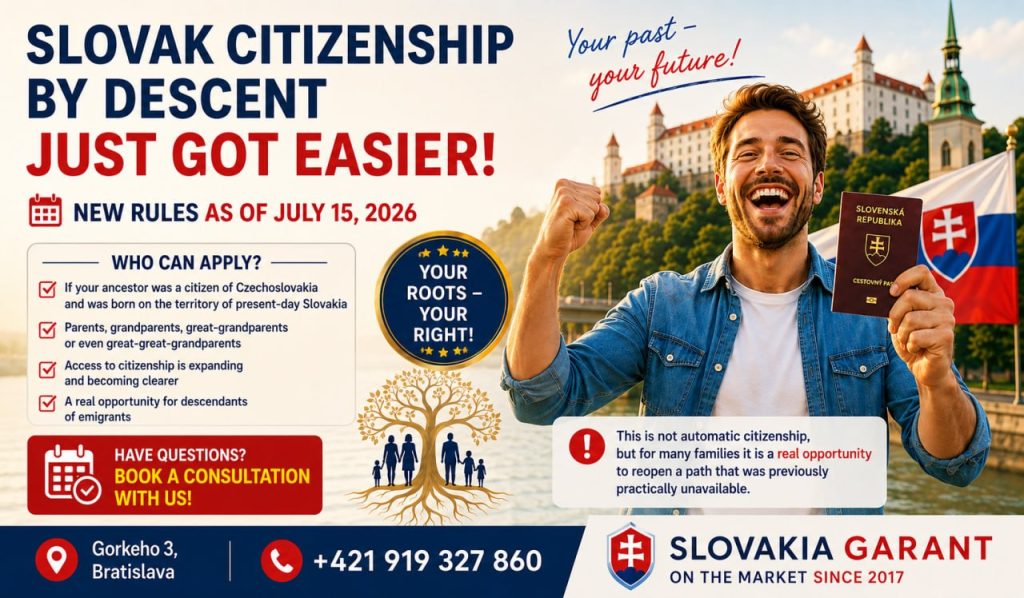
Effective July 15, 2026, the requirements for obtaining citizenship in Slovakia have changed for descendants of former Czechoslovak citizens. This applies to individuals who have at least one parent, grandparent, great-grandmother, or great-grandfather who was a citizen of Czechoslovakia and was born within the territory of the present-day Slovak Republic.
The main change concerns residency in Slovakia.
Under the old system, simply having a Czechoslovak ancestor did not exempt the applicant from the requirement to have authorized residence in Slovakia. In practice, a person first had to obtain a Slovak residence permit or establish another legal basis for residence, and when reviewing the application, the government agency could verify whether the person had actually been in the country, how long they had been absent, and the reasons for their departure.
This was precisely what posed the main obstacle. A person could provide documentary evidence that his or her parent, grandfather, or great-grandfather was a citizen of Czechoslovakia and was born in what is now Slovakia, but could not immediately apply for citizenship unless he or she had the required residency status.
Under the new rules, the residency requirement in Slovakia for this category is being eliminated.
Now, a descendant of a former Czechoslovak citizen does not need to first obtain a residence permit solely for the purpose of applying for citizenship, does not need to have resided in Slovakia for eight years, and does not need to prove their actual presence in the country or explain periods of absence.
But that doesn’t mean that citizenship is granted solely on the basis of the grandfather’s birth certificate.
The applicant must still confirm two key facts. First: the ancestor was indeed a citizen of Czechoslovakia. Second: this ancestor was born in a territory that is now part of the Slovak Republic. In addition, the entire line of descent from the ancestor to the applicant must be documented.
For example, if the basis for the claim is the great-grandfather, you will need documents linking the great-grandfather to the grandfather or grandmother, then linking them to one of the applicant’s parents, and linking that parent to the applicant. These are typically birth certificates, marriage certificates, documents regarding a change of surname, and other civil status records.
If the grounds have already been verified and the documents proving origin have been gathered, the application must be submitted in person. If you are in Slovakia, you can submit it to the district office located in the administrative center of the region. If the applicant lives abroad, the application can be submitted in person at an embassy or consulate of the Slovak Republic. The application for citizenship itself still cannot simply be sent by regular mail or email. The official procedure requires in-person submission.
The application must be accompanied by a passport or other form of identification, the applicant’s birth certificate, documents regarding marital status, a detailed biography, documents regarding the citizenship and place of birth of the Czechoslovak ancestor, as well as all documents confirming the family relationship.
In addition, certificates of no criminal record are typically required from the applicant’s country of citizenship, from countries of which the applicant was previously a citizen, and from countries where the applicant had authorized residence during the period specified by law. The specific list depends on the applicant’s background, citizenship, places of residence, marital status, and the documents on which the application is based.
Documents issued outside Slovakia generally must be accompanied by the required international certification, such as an apostille or consular legalization, unless an international treaty provides for an exemption. They are then translated into Slovak by a certified translator.
When an application is submitted in person, an employee verifies the applicant’s identity and accepts the application and supporting documents. If any documents are missing or there are discrepancies among them, the government agency may request additional information.
Differences in surnames and first names are particularly important here. For example, a person’s first name might be written in Slovak or Hungarian in a Czechoslovak document, but in a different transliteration in a Ukrainian or Soviet document. Such differences must be explained in advance and supported by documentation; otherwise, the government agency may not recognize the family relationship as proven.
After accepting the documents, the district office or consulate forwards the application to the Slovak Ministry of the Interior, which reviews the case and makes a decision. Meeting the eligibility criteria entitles the applicant to file an application under simplified conditions, but does not guarantee automatic granting of citizenship. The Ministry verifies the authenticity of the documents, the applicant’s origin, identity, and criminal record, as well as compliance with all other legal requirements.
Following a positive decision, the applicant receives a document granting citizenship and acquires citizenship after completing the procedures required by law, including taking the oath, unless the applicant is exempt from doing so.
There is another new simplification. After receiving the document granting citizenship, a person will be able to apply for Slovak civil status documents and register their permanent residence within 90 days, without having to wait for a separate certificate of citizenship.
Also, starting July 15, an application for a certificate of Slovak citizenship—if such a certificate is needed at a later date—can be submitted through a Slovak diplomatic mission abroad not only in person, but also by mail or electronically. However, this change applies specifically to the certificate of citizenship, not to the initial application for citizenship. The initial application must be submitted in person.
Simply put, in the past, a person of Slovak descent effectively had to first establish a basis for residing in Slovakia and only then proceed toward citizenship. Now, if an ancestor’s Czechoslovak origin and citizenship are confirmed, an application can be filed without a prior residence permit and without having resided in the country for eight years.
But the main step remains the same: first, you need to verify the legal basis, obtain documents proving your ancestor’s citizenship, and establish an unbroken chain of descent. Only after that does it make sense to translate the documents, prepare the application, and schedule an in-person submission.
If your family included Czechoslovak citizens who were born in what is now Slovakia, Slovakia Garant can review your eligibility, identify any missing documents, assist with archival requests, and prepare a complete application package for citizenship.