Starting July 15, the rules for foreigners in Slovakia are changing. It’s important not to fall for sensational headlines.
When people hear that a new law on the residence of foreigners has been passed, they usually expect one simple answer: Has it become easier or harder?
But immigration laws almost never work that simply. For one person, a new regulation may indeed pave the way to a residence permit. For another, it will create an additional risk. And a third person may decide that the change doesn’t apply to them at all, even though the police will now be able to scrutinize their documents much more closely.
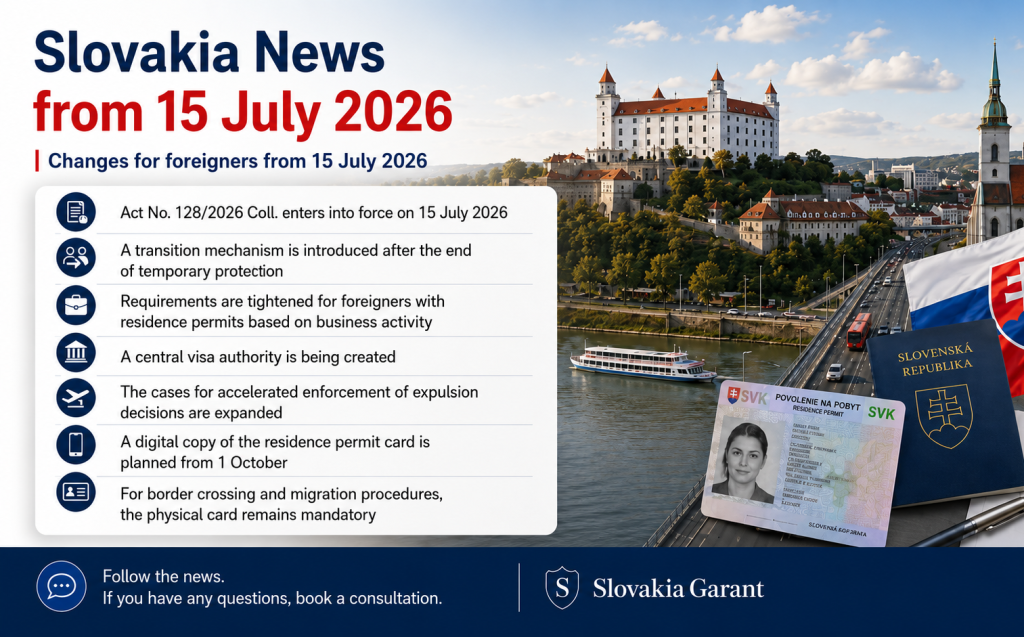
On July 15, 2026, Act No. 128/2026 Z. z. will take effect, amending several provisions of the Act on the Residence of Foreigners.
The first important topic concerns people with temporary asylum—or, as many people say, temporary protection.
The law establishes a mechanism to be applied after the temporary asylum program ends. Such a person will be able to apply for a temporary residence permit if they can demonstrate a specific basis for their stay and provide the necessary documentation.
Simply put, the mere fact that a person has lived in Slovakia for several years under temporary protection will not be enough. A valid basis for a residence permit will be required: employment, self-employment, education, family reunification, or another option provided for by law.
If a person does not apply for a residence permit, the law allows them to remain in Slovakia for up to one additional year, but only to prepare for their voluntary return home.
And here it is very important to understand the wording correctly. This is not an additional year of full-fledged residence, work, and building a new life in Slovakia. It is a period granted for departure. Furthermore, this right of residence will expire if the person leaves Slovakia.
Therefore, it would be a serious mistake to view this year as an extension of temporary protection or as yet another year during which no decisions need to be made.
The second important change concerns foreigners who hold a temporary residence permit for entrepreneurial activities.
Previously, the absence of outstanding debts was checked particularly thoroughly when renewing a residence permit. Now, the law’s requirements have become stricter: an entrepreneur must not have any outstanding debts throughout the entire duration of their residence.
This means that the issue of debt can no longer be put off until the card is renewed.
This may not be limited to debts owed to the tax authorities or the Social Insurance Agency. The law applies a broader concept of obligations to other entities. Therefore, it becomes even more important for foreign entrepreneurs to regularly check the status of their company or živnost, pay their obligations on time, and not assume that their accountant will automatically take care of everything.
A single unpaid obligation does not automatically result in the loss of your residence permit the very next day. However, it could serve as grounds for an investigation and create a problem even before you apply for renewal.
The third change concerns visas. A regional central visa authority is being established under the Ministry of Foreign Affairs, which will be able to make decisions on visa applications just as consulates do.
It is expected that this will allow for the redistribution of applications and speed up processing in cases where consulates are overburdened. However, for applicants, this also means that a decision on their case may not be made by the consulate where they submitted their documents.
The fourth topic concerns administrative expulsion.
There are an increasing number of cases in which a deportation order may be enforced immediately upon service, without waiting for the standard 30-day period to elapse. This is possible if the police consider the person a threat to security or believe that he or she may flee or obstruct the enforcement of the order.
For most foreigners who live and work legally in Slovakia, this change should have no direct practical impact. But it illustrates a general trend: the government distinguishes between routine administrative violations and situations in which it perceives an increased risk.
Finally, starting October 1, 2026, it should be possible to create a digital copy of a residence permit in a mobile app.
It sounds convenient, but it’s too soon to throw away your plastic card.
A digital document cannot be used in place of a physical card when passing through border control or in procedures conducted under the law governing the stay of foreign nationals. A plastic card will remain necessary for travel, submitting documents, and interacting with foreign police.
The main conclusion here is very simple.
The law does not grant all foreigners a single, uniform exemption, nor does it impose a single, uniform prohibition. It establishes different rules for different situations.
It is important for people with temporary protection to understand now on what grounds they will be able to transition to a residence permit. Entrepreneurs need to keep track of their outstanding debts not only before renewal, but on an ongoing basis. Those who have committed immigration violations or are at risk of deportation should not wait until the very last day to seek legal protection.
When it comes to immigration issues, problems often arise not when a person has done nothing at all, but when a person has acted according to the old rules and failed to notice that the rules have already changed.
Subscribe and stay up to date.
Because if you know the rules, you’ll be able to protect your interests in a timely manner. If you don’t know the rules, even a small mistake could cost you time, money, and your right to stay.
As always, Slovakia Garant is here for you.
And if you want to understand exactly which change applies to your situation, you can always schedule a consultation with the appropriate specialist